Case study · HelloWorld PC 2023
Live · Emails Classifier and HITSThe AI partner behind two software products.
HelloWorld PC, a software consultancy in Athens, wanted AI at the heart of two new products and had no data science team in-house. DataMinds joined as the external AI partner: research, proofs of concept, design and an implementation plan for every AI component, worked out twice a week with the developers who would build them.
2
Products shaped
2
Meetings a week
4
Classifier functions
7
HITS capabilities
Where the work lives
- HelloWorld PC
A global software consultancy in Halandri, Athens. Software, UX, product development and training.
- Emails Classifier
Email classified, routed, answered and acted on. Standalone, or inside an existing system.
- HITS
Hello Intelligent Transcriptions Service: recorded calls turned into text, summaries, fields and scores.
The challenge
AI products, without a data team to design them.
HelloWorld builds software for other companies: web and cloud systems, product design, modernisation. In 2023 it set out to build products of its own, with AI doing the work at the centre. One would read a company's email and decide what happens to each message. The other would turn recorded calls into text, summaries, fields and scores.
Its developers could ship anything with a clear specification. What they did not have was someone to write it: which models, which approach, what would fail, and how anyone would know. Hiring a data scientist for two early products made little sense. What the company needed was an AI partner who could do the research, prove the risky parts on real data, hand over designs and plans the team could build from, and be in the room twice a week while they did.
Product 01 · Emails Classifier
An inbox that sorts itself, and acts.
Emails Classifier reads incoming email, classifies it against the criteria a company sets, and then does something about it: forwards it to the right people, answers it, or triggers another system. It runs on its own or inside an existing product, and customers pay for the functions they use.
- Classifications
- Every email tagged and sorted by the criteria the company sets: topic, urgency, customer, case.
- Forwarding to stakeholders
- The right message reaches the right person, with no human triage step in between.
- Automated answers
- Replies for the questions that repeat, drafted by the system on the company’s rules.
- External services triggering
- An email can open a ticket, update a CRM record or start a workflow in another system.
Our part
The research into how to classify and route email reliably, a proof of concept on real messages, the design of the classification and routing components, and the plan to build them into the product.

Product 02 · HITS
Every recorded call, turned into text and decisions.
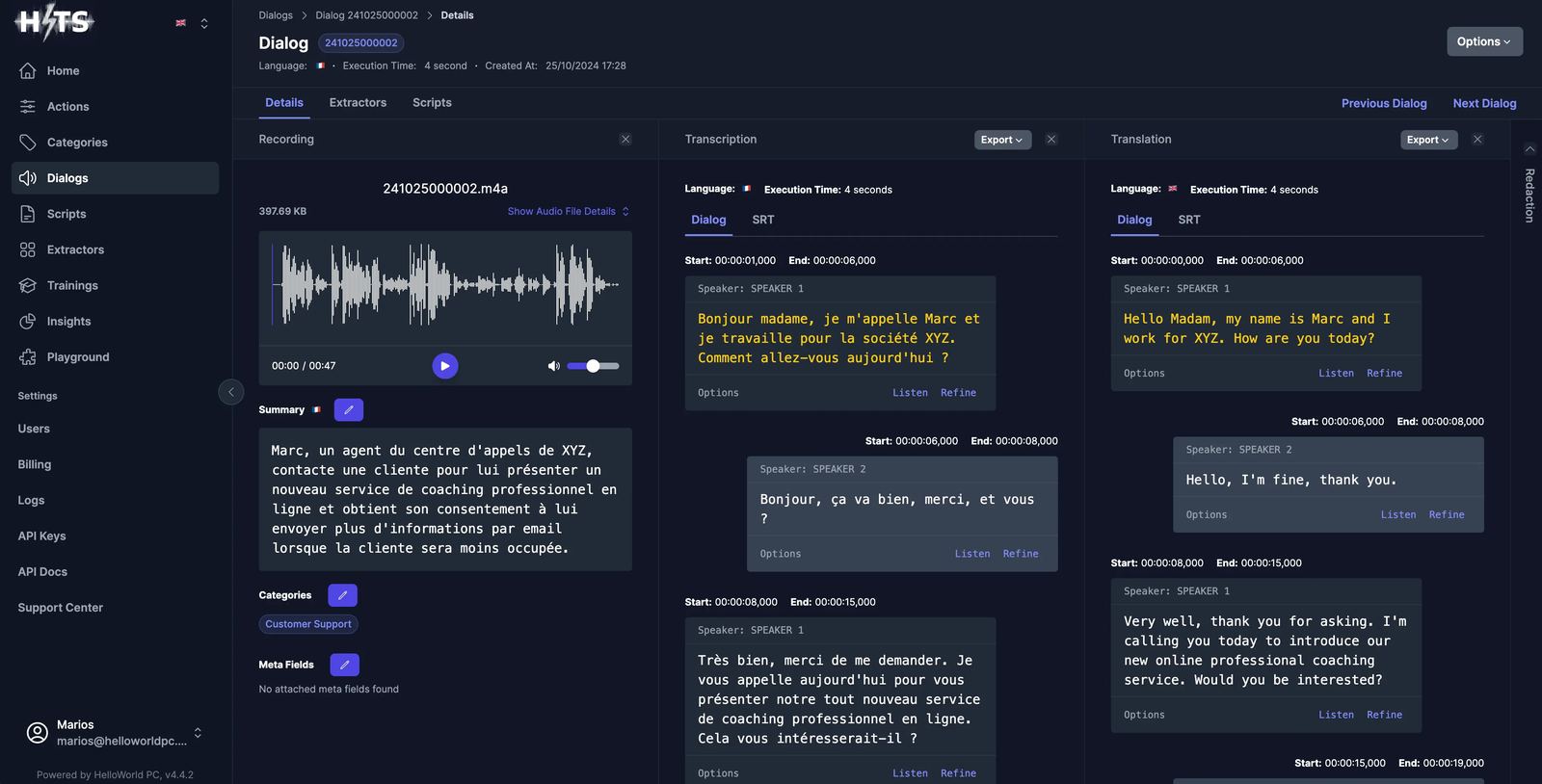
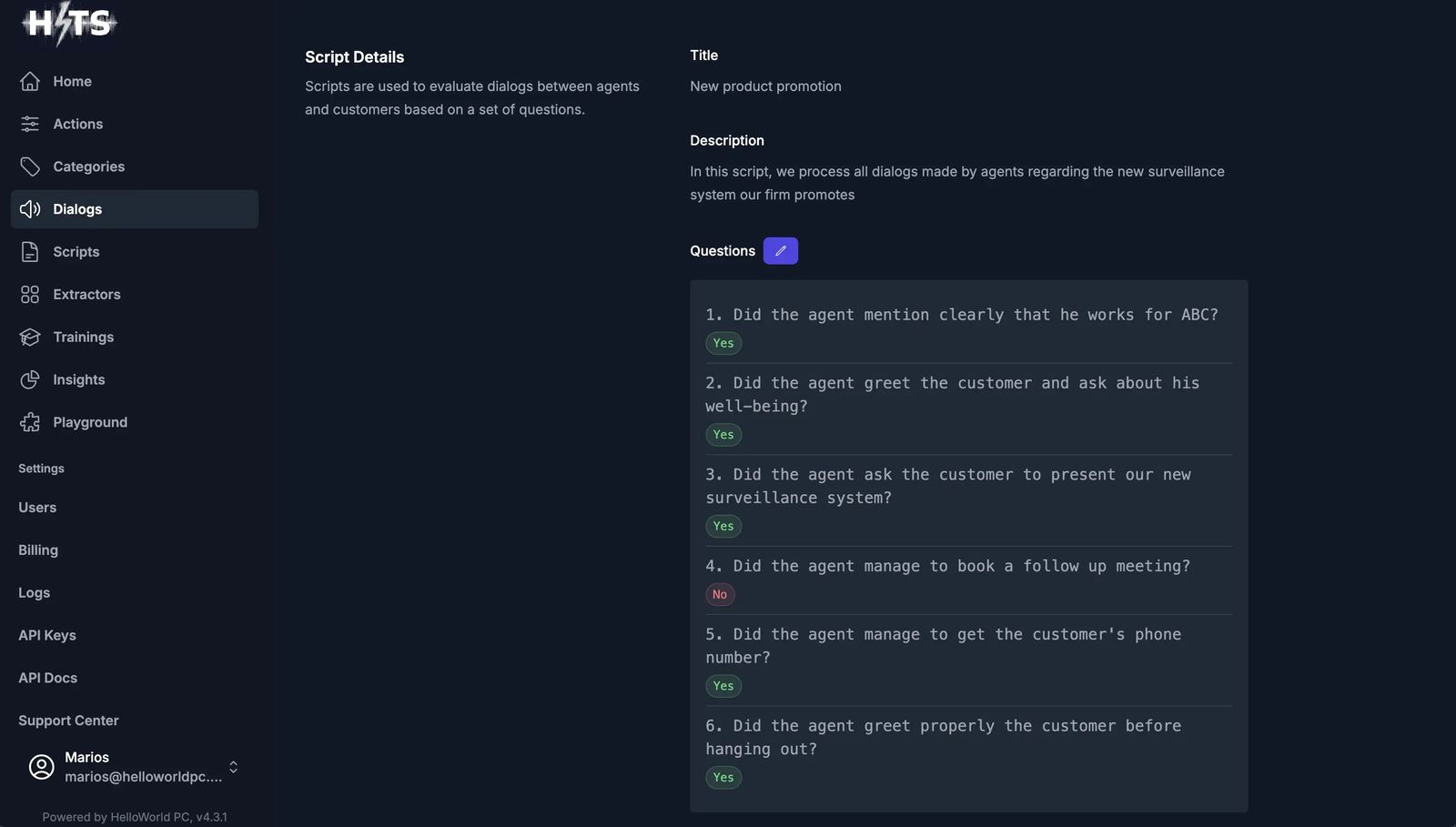
HITS, the Hello Intelligent Transcriptions Service, processes call recordings in batches: it transcribes and separates the speakers, translates, summarises, redacts, classifies, extracts the fields a CRM needs, and checks whether the agent followed the script. It runs in HelloWorld's cloud or in the customer's own, with no internet access where compliance demands it.
- Transcription and diarisation
- Audio to text, with each speaker’s turns kept apart.
- Translation
- The same dialogue in another language, beside the original.
- Classification
- Every call filed by client, project code or any structure the customer defines.
- Summarisation
- A summary shaped by the keywords, topics or sentiment that matter to the business.
- Redaction
- Sensitive details removed by rule, or by hand.
- Fields extraction
- A predefined set of fields sent to the CRM or ERP through a callback.
- Script adherence
- Each call scored against the questions the agent should have asked.
Our part
The research into speech-to-text and language models for call audio, proofs of concept on recordings, the design of the processing pipeline, and the risks a system like this carries with a mitigation for each: accuracy across languages and accents, speaker separation, the handling of personal data, and the cost of every minute processed.
How we worked
Research, prove, design, plan. Twice a week.
The AI components were the risky part of both products. Our job was to take the risk out before the developers wrote production code, and to be in the room while they did.
01
Start from the product, not the model
Design-thinking sessions with HelloWorld's product and development people: who each product is for, which decision the AI makes for them, and what a wrong answer costs. Those sessions fixed the scope of every AI component before any research began.
02
Research what the state of the art can do
For each component, a written review of the approaches available in 2023, from established models to the large language models arriving that year, with what each would cost, how it would fail and what it needed to run. Delivered as reports the team could keep.
03
Prove the risky parts on real data
Proof-of-concept implementations for the components that carried the most uncertainty, run on HelloWorld's own data. The point was not a demo. It was a number the team could plan around, and an early look at the failure cases.
04
Design it so the developers can build it
Design diagrams for the AI components and their place in each product: inputs, models, outputs, and the boundaries with the rest of the system. A risk register alongside, with a mitigation for every risk that survived the proofs of concept.
05
Hand over a plan, and stay in the room
An implementation plan for the AI components, in the order that retired risk fastest, written for HelloWorld's developers. Two meetings a week through the engagement kept the plan and the code in step.
Timeline
Four months, kickoff to hand-over.
May 2023
Kickoff. Design-thinking sessions with the product and development people fix what each AI component decides and what a wrong answer costs. The twice-weekly meetings begin.
Jun 2023
Research reports on the approaches for email classification and for call audio, and the first proofs of concept on HelloWorld's own data.
Jul 2023
The proofs of concept finished and measured. Design diagrams for the AI components, and the risk register with a mitigation for each risk.
Aug 2023
The implementation plan for the AI components, in build order, handed to the developers. The engagement closes and HelloWorld's team builds on.
What HelloWorld kept
Five deliverables, and a cadence.
Nothing here was a slide deck for a steering committee. Each piece was written for the developers who would build the products, and each one stayed with them.
Written
Reports
Research on each AI component: the approaches, the trade-offs, the costs, and a recommendation.
Code
Proofs of concept
Working implementations on real data for the components with the most uncertainty.
Drawn
Design diagrams
Each AI component and its place in the product, ready for the developers to build from.
Register
Risks and mitigations
What could go wrong with each component, and what to do about it before it did.
Sequenced
Implementation plan
The AI components in build order, with what each step needs and what it proves.
The cadence
2 × a week
for four months, May to August 2023, with the developers building the products.
The AI work and the product work never drifted apart.
The result
Both products live, run by HelloWorld's own team.
Both products are live. Emails Classifier is sold from helloworld.gr as a standalone product or as a component of a customer's system. HITS runs at hellotranscriptions.com, in HelloWorld's cloud with a published 99.99% availability agreement, or in the customer's own cloud with no internet access at all.
The production code was written by HelloWorld's developers from the start, so there was no hand-over at the end and no dependency on us after it. What DataMinds left behind is the part a software company cannot easily hire for two early products: the research, the proofs, the designs and the plan.
This is what our consulting engagement looks like from the inside. Not a strategy document, but an AI partner beside your developers, twice a week, until the risky parts are understood, proved and planned.
Working with DataMinds
- In the room
- Two meetings a week with your developers, for the whole engagement.
- Research, written down
- Reports on the approaches that fit your product, with the trade-offs and the costs.
- Proof before production
- Proofs of concept on your data for the components that carry the risk.
- Designs your team can build
- Diagrams, a risk register and an implementation plan for the AI components.
- Your code, your product
- Your developers build it and own it. We make sure they can.
Building AI into your product?
Bring us in beside your developers. Research, proofs of concept, designs and a plan for the AI components, worked out with your team twice a week. First results in weeks, not quarters.