
Case study · RotoGPT 2023–24
Live · rotogpt.com and the App StoreAn assistant that knows fantasy football.
RotoGPT, a fantasy sports company in the United States, wanted an assistant that answers the questions fantasy managers ask every week, from this week's data and the rules of their own league. DataMinds built the backend and the AI layer, from the first prompt to the API the app runs on.
6
League platforms
3
Live data feeds
10
Tools in the app
10
Months to build
The product
One chat, and nine tools around it.
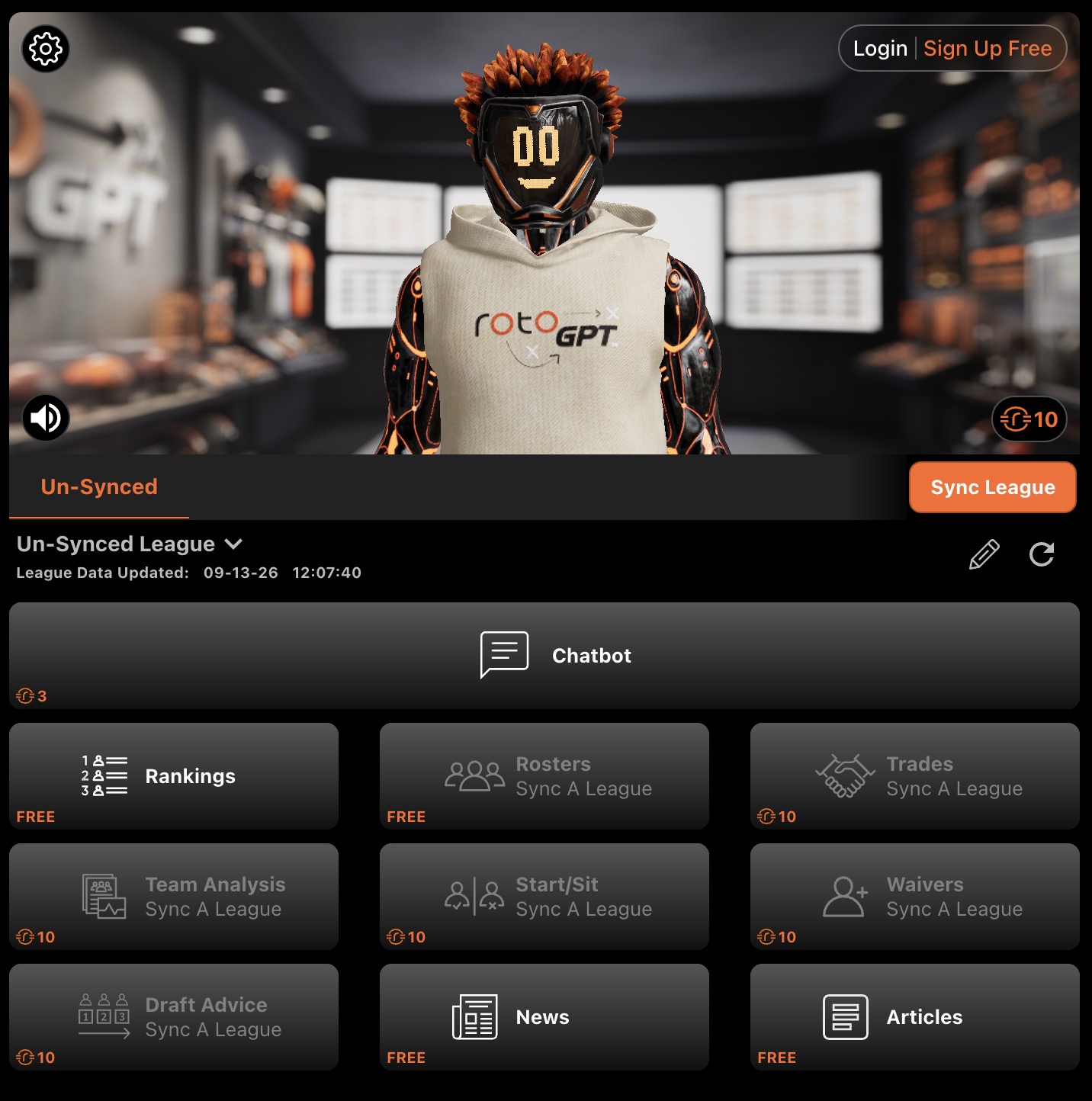
Ask the chatbot anything about your league, or go straight to the tool for the decision in front of you. Every tool runs on the same engine and the same player profiles.
- Chatbot
- Any question about your league, in plain language, answered with the reasoning.
- Rankings
- Weekly rankings by position, in your scoring format.
- Rosters
- Every team in your league, synced from the platform it runs on.
- Trades
- Both sides of a proposal, judged on current player values.
- Team analysis
- Where your roster is strong, where it is thin, and what to do about it.
- Start/Sit
- The lineup call for this week, matchup by matchup.
- Waivers
- Who to claim, who to drop, and why.
- Draft advice
- Pick by pick, for your slot and your format.
- News
- Player and team news as it lands.
- Articles
- Analysis from the fantasy press, in one place.
The result
Live for the 2023 season, and still running.
RotoGPT opened to fantasy managers during the 2023 NFL season, on the web first. A manager syncs their league, and every tool answers within that league's format, scoring and rosters. The same product is now in the App Store.
The difference from a general chatbot is not the model. It is what the model is handed: the player's statistics, news and value, and the rules of the league the question comes from. An answer that is right in general is often wrong for your league.
RotoGPT puts it in nine words: "RotoGPT isn't a search engine; it's a reasoning engine."
What we delivered
- The API
- A FastAPI service behind the chat and every tool.
- The data engine
- Three feeds pulled on a schedule into MongoDB, merged into one profile per player.
- The prompts
- One per tool, tuned on real questions, with the league's rules in context.
- The model layer
- OpenAI models called through one interface, so the model can change without the product changing.
- The repository
- Code, prompts and pipelines in GitHub, documented for the team that runs them.
The challenge
Advice that is right this week, in your league.
Fantasy football is a weekly decision under uncertainty. Who starts, who sits, which trade to accept, whom to claim off waivers. The answers depend on injuries, depth charts and matchups that change by the day, and on the format and scoring of the league you play in.
A general language model knows none of that. Its knowledge stops at its training date, and it has never seen your league. RotoGPT asked for an assistant that reads the live data first and reasons within the league's rules, and answers in seconds rather than after an evening of research.
The data
Three feeds, one profile per player.
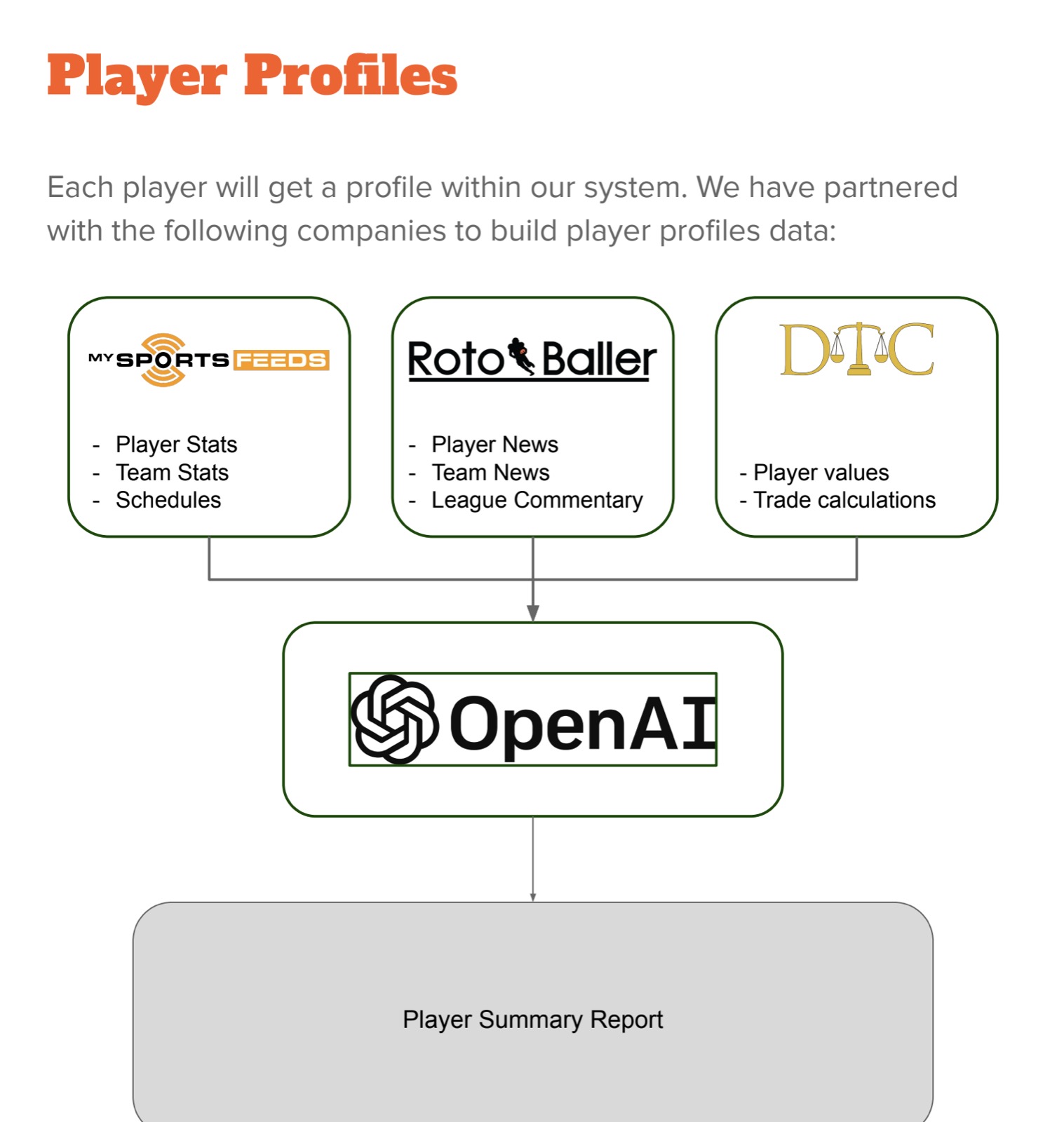
Each NFL player gets a profile in the system, built from three commercial feeds and refreshed through the week. The model never answers from memory. It answers from the profile.
Statistics
MySportsFeeds
Player statistics, team statistics and the schedule. The numbers behind every ranking and every lineup call.
News
RotoBaller
Player news, team news and league commentary, so an injury or a depth-chart change is in the answer the same day.
Values
Dynasty Trade Calculator
Player values and trade calculations. The basis for judging both sides of a proposal.
Synced
The manager's league
Format, scoring, rosters, the waiver wire and matchups, read over a read-only connection from the platform the league runs on: Sleeper, ESPN, Yahoo, Fantrax, MFL or Fleaflicker. The context every answer is written in.
The idea
One profile per player
assembled from the three feeds and handed to the model together with the question and the league's rules.
A search engine returns pages. This returns a decision, with the reasons.
How we built it
Give the model the data. Then ask the question.
The model was the easy part. The work was the engine around it: profiles that are current, prompts that carry the league's rules, and an API the app could grow on.
01
Start from the questions managers ask
Start or sit. Accept or decline. Claim or drop. Draft whom. Each became a tool with its own inputs and its own idea of a good answer. That list shaped the data engine and the prompts, and it is the list on the home screen today.
02
Build a profile for every player
Statistics from MySportsFeeds, news and commentary from RotoBaller, values from Dynasty Trade Calculator. Pipelines pull each feed on a schedule into MongoDB and merge them into one profile per player, refreshed through the week.
03
Put the league in the prompt
A manager syncs their league, and its format, scoring and rosters travel with every question. The prompt for each tool selects the profiles that matter and states the rules, so the model reasons about this league, not the average one.
04
One API behind every tool
A FastAPI service serves the chat and the nine tools from the same engine. The app asks, the API assembles the context, calls the OpenAI model and returns the answer with its reasoning. Prompts and pipelines live in the repository, not in the model.
05
Tune on real questions through the season
The prompts were revised on real questions as the 2023 season ran, tool by tool. When the season closed, the engine, the API and the prompts were documented in GitHub for the RotoGPT team to run on.
Under the hood
The engine is a transformer. The driver is RotoGPT.
A large language model is the engine. The driver is everything built around it: the data engine, the retrieval, the league context and the prompts. That is where the engineering lives, and it is why the same question gets a different answer in every league.
“We use state-of-the-art transformer technology as our engine, but the driver is purely RotoGPT.”
01 · The question
A manager types it in plain language or opens one of the tools. Premium users can say it out loud.
02 · The league
Rosters, scoring settings, the waiver wire and this week’s opponent, read over a secure, read-only connection to one of six platforms.
03 · Retrieval
The data engine pulls what matters from live statistics, news, depth charts, historical trends and player values. Nothing comes from the model’s memory.
04 · Reasoning
The model works through that context under the league’s rules. Advanced Reasoning thinks longer, runs more scenarios and weighs bye weeks and playoff schedules.
05 · The answer
A recommendation with its reasoning: matchup data, usage rates, defensive weaknesses. One query, one credit, because each answer costs real compute.
Two managers can ask the same question and get two different answers. That is not a bug in the driver. It is the point of it.
The AI layer
Grounded, current, and honest about what it knows.
RotoGPT describes its model as fine-tuned exclusively on NFL and fantasy football data. The rest of the AI layer exists to keep that model tied to this week’s facts and this league’s rules. Six choices do most of the work.
Grounding
Retrieval, not recall
Retrieval-augmented generation holds the model to the data repository. A stat in an answer comes from an NFL log, not from what the model remembers, which is how hallucinations are kept down.
Freshness
Minutes, not seasons
Live news and stat feeds keep the knowledge base current. A surprise inactive tag or a practice-squad elevation reaches the advice within minutes, not in the next training run.
Context
The rules in the prompt
PPR, half-PPR, TE premium, roster depth, the opponent’s lineup. Every prompt states the league’s parameters, so the model calculates for this league rather than the average one.
Objectivity
No learning of habits
The system does not adapt to a manager’s past moves, so the advice stays statistically grounded every time. It does keep the current conversation, so a follow-up question lands on the right trade.
Depth
Advanced Reasoning
A Premium mode that makes the model think longer: several simulations, secondary effects such as playoff schedules and bye-week crunches, and the why behind every move spelled out.
Cadence
Shipped daily
The product runs in the cloud, so model improvements and data patches go out daily. No off-season update; as the NFL moves, the engine moves with it.
Timeline
Ten months, kickoff to the off-season.
Jun 2023
Kickoff. The questions the assistant must answer, the feeds to license and the shape of the player profile.
Jul 2023
The data engine: pipelines for the three feeds into MongoDB, one profile per player. RotoGPT opens its X account.
Aug 2023
The API and the first prompts. Draft season, so draft advice is the first tool managers need.
Sep 2023
The NFL season opens on 7 September. Start/sit, waivers and trades run against synced leagues.
Oct to Dec 2023
In-season tuning on real questions, week by week. Rankings, team analysis and news alongside the chat.
Jan 2024
Fantasy playoffs and the NFL postseason. The prompts settle; the engine keeps refreshing.
Feb 2024
Super Bowl LVIII, 11 February. The season closes and the review of what worked begins.
Mar 2024
Hand-over. Code, prompts and pipelines documented in GitHub for the RotoGPT team.
An assistant for your domain?
A model on its own knows nothing about your business. We wire it to your data and your rules, measure the answers, and ship it in your channels. First version in weeks.